About this document
This Technical Note describes a structure that replaces the body of a solar cell's front collecting electrode, the part that sets silver usage, with copper. It sets out an electrode design and process that split the roles among PDA adhesion, copper wiring and a Ni-based diffusion barrier.
Download
An English edition is not available yet. The Korean document is below.
Summary
In conventional silver electrodes the glass frit aids adhesion and contact, but silver consumption is set by the electrode body. Assigning adhesion to PDA, current transport to frit-free copper and copper diffusion blocking at the contacts to a Ni-based layer replaces the silver in the body with copper. The note covers the process sequence, a cross-section calculation and a design scenario cutting silver per cell by 85–90%.
Conclusion
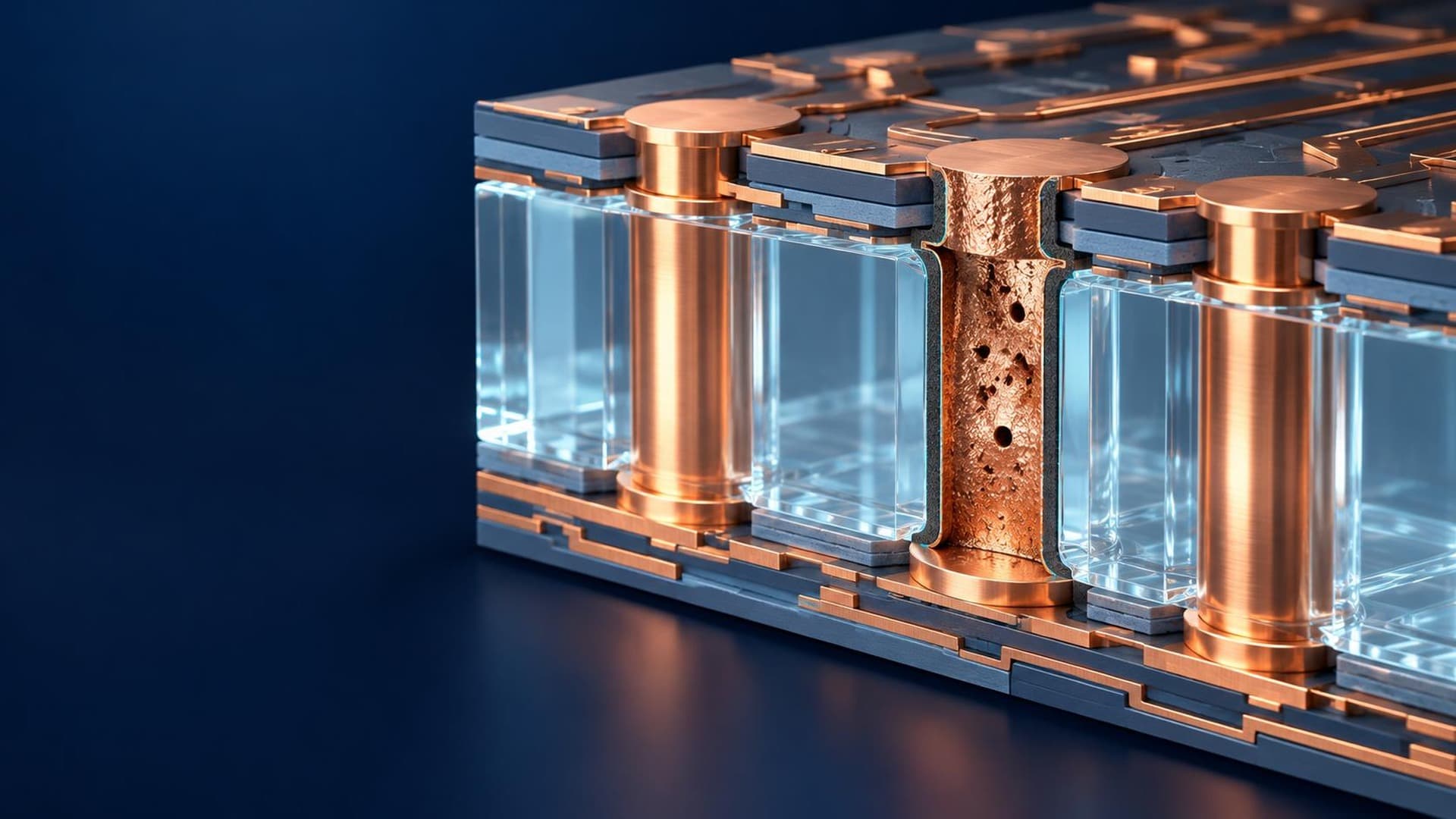
The fine silver lines on a solar cell's surface collect the generated current. The document cites total photovoltaic silver demand of about 5,800 tonnes in 2025 while noting that not all of it is open to substitution. In existing silver electrodes the glass frit takes part in adhesion and contact formation during firing, and the electrode body determines silver consumption. The Cools structure separates three roles. PDA at the bottom bonds the copper line to the substrate, the copper body carries the main current, and a Ni-based layer at the contact blocks copper diffusion. PDA is applied only to adhesion areas and metal contact surfaces stay exposed. The process forms metal contacts and a Ni-based diffusion barrier after laser opening, applies PDA selectively without covering the contacts, prints frit-free copper and sinters it under a protective atmosphere, where limited oxygen exposure and reducing conditions control copper oxidation and a surface protection layer is formed. The document notes that laser opening alone does not produce a low-resistance contact, and that PDA adhesion after sintering and suppression of copper oxidation are evaluated together. At equal line length and resistance, the required cross-section scales with resistivity (R = ρL/A). Using a literature silver sample at 5.09 μΩ·cm and a copper manufacturer's case at 5.00 μΩ·cm as calculation bases, the document puts the required copper cross-section at 98.2% of the silver one. This is not a measurement of the Cools PDA structure. Silver per cell is shown in a scenario that replaces 90 mg of a 100 mg calculation baseline with copper. The remaining silver is the retained 10 mg plus any silver added for contacts and protection: 10 mg (a 90% reduction) with none added, 15 mg (85%) with 5 mg, and 20 mg (80%) with 10 mg. The document compares this with a frit-free silver electrode design calculated on the same basis (47.8 mg). At an unchanged silver price, silver material cost falls in proportion to usage, but total manufacturing cost also includes copper paste, contacts, PDA, sintering and protection steps, and yield. As external evidence, Fraunhofer reports 1.1 mg Ag/Wp at 24% efficiency for plated Ni/Cu/Ag electrodes; the Cools PDA, printing and sintering structure is a development proposal.
Topics
- Solar
- Printed electronics