About this document
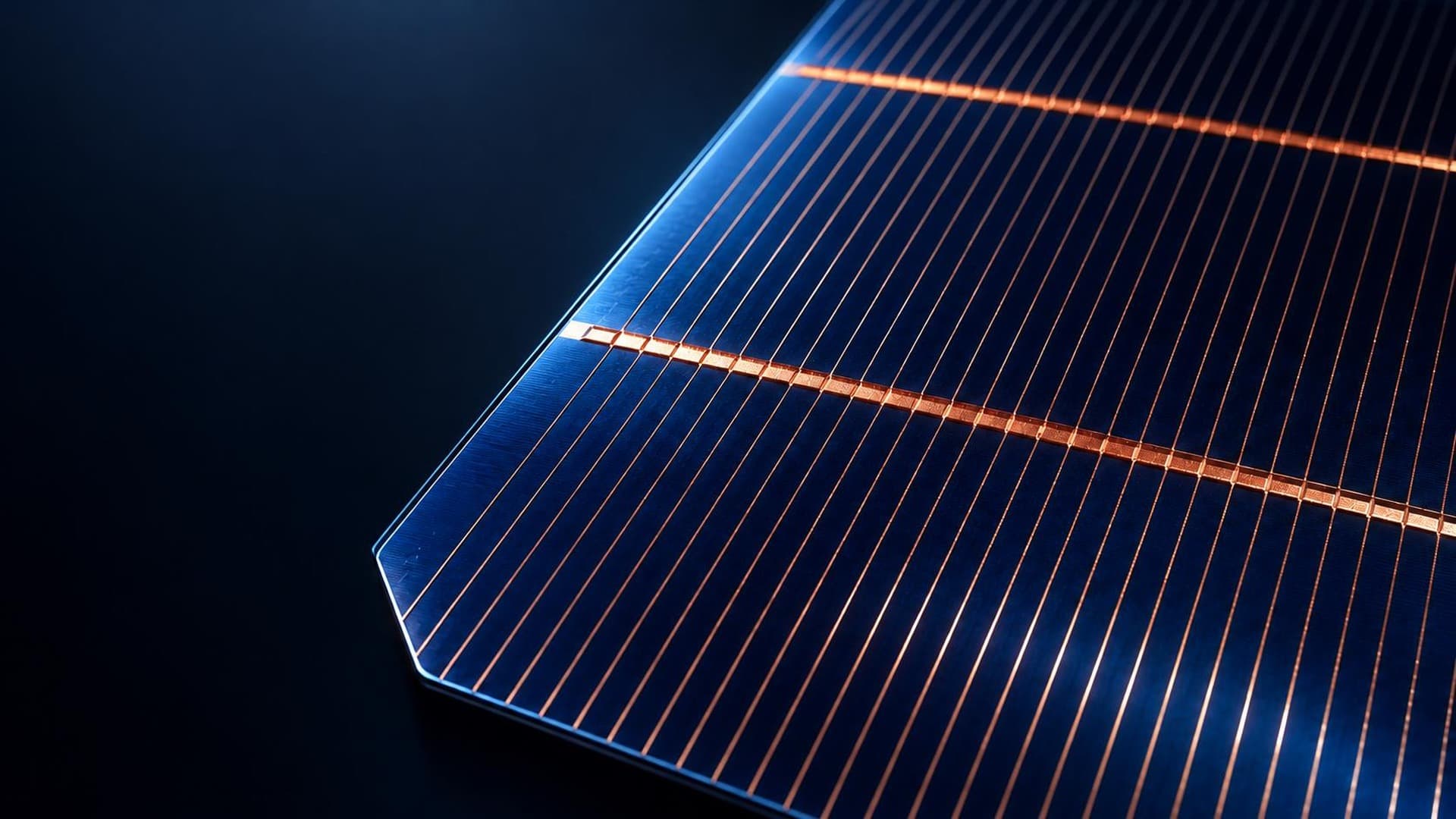
This Technical Note addresses the visible cell grids and electrodes that keep solar modules from looking like uniform architectural glass. It describes a module that cancels cell-side reflections with a circular-polarizing front layer and moves absorbed heat away from the cells.
Download
An English edition is not available yet. The Korean document is below.
Summary
In BIPV, cell grids, metal electrodes and cell gaps show through, and colored or black treatment layers absorb light and heat that should reach the cells. A circular-polarizing front layer made of a linear polarizer and a quarter-wave plate absorbs light returning from the cell side in one step, and polarizing only the visible band lets near-infrared light reach the cells for power generation.
Conclusion
Building-integrated photovoltaics are judged on power output and on how the facade looks: its expression, reflections and finish. In conventional modules, surface reflection from the front glass, the color and pattern of the cell surface, glints from metal electrodes and wiring or backsheet visible in the cell gaps each show through in a different way. AR coatings and surface texturing, colored layers and structural color, and back-contact cells each address only one or two of these, and colored or black treatment layers absorb light that would reach the cells along with the reflection, passing the absorbed heat into the cells and lowering output as they warm. Cools' CoolSolar controls the round-trip optical path that all cell-side reflections share. A linear polarizer faces the incoming light and a quarter-wave plate faces the cells, with their axes aligned at 45° (stack: front glass, linear polarizer, quarter-wave plate, encapsulant and cells, back protection layer). Incoming light becomes circularly polarized; on reflection from cells, electrodes or gaps its handedness reverses, and after passing back through the wave plate it becomes linearly polarized perpendicular to the transmission axis and is absorbed by the polarizer. Because light returning from every reflection site passes through the same front layer, cell, electrode and gap patterns are hidden together. Heat is handled at the front layer. Heat generated by polarization absorption is released from the front surface to the outside air, moving the heat source away from the cells and reducing non-generating absorption inside them. Polarization is applied only in the band the eye sees. In the document's spectral calculation (AM1.5G, representative crystalline Si EQE, CIE luminosity function, 44% transmission in the polarized band and 92% outside it), polarizing only 480–650 nm covers 95.6% of visible reflection while 72.3% of the Si photocurrent reaches the cells through the unpolarized band, giving an effective transmittance for crystalline Si cells of 78.7% versus 44.0% for full-band polarization. The structure is a flat module laminating glass, optical film and encapsulant without concentrators. An optical film combining the polarizer and wave plate sits between the front glass and the cells, with axis alignment, bubbles, wrinkles and stress birefringence, UV and moisture barriers, and optical stability under heat, humidity and UV as the control items. It applies to IBC, TOPCon, HJT and tandem cells and can extend to opaque facades of offices, hotels and public buildings, roofs, canopies and curved facades built from segmented modules.
Topics
- Solar