About this document
This Technical Note explains how a PDA coating lets electroless copper form on PTFE, a surface copper does not readily adhere to, in order: dopamine's functional groups, the reactions that form PDA, follow-on reactions of the remaining groups and the copper plating bath.
Download
An English edition is not available yet. The Korean document is below.
Summary
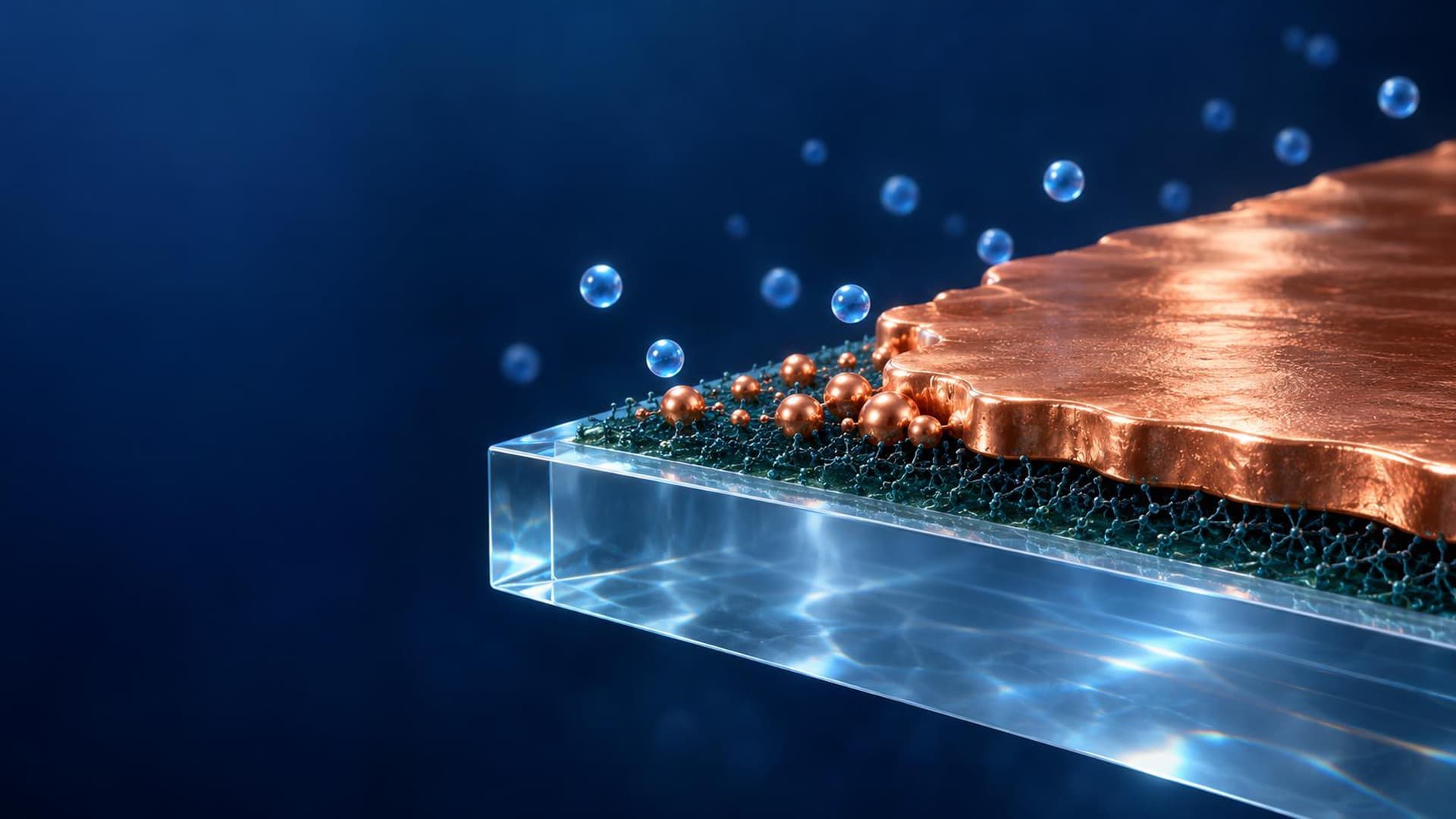
Dopamine's catechol and amine groups oxidize and cyclize in a mildly alkaline solution to form a PDA layer. PDA lowers the water contact angle of PTFE from 106° to 49°, and its remaining groups hold copper ions, providing the starting point for growing a continuous copper film by DMAB reduction.
Conclusion
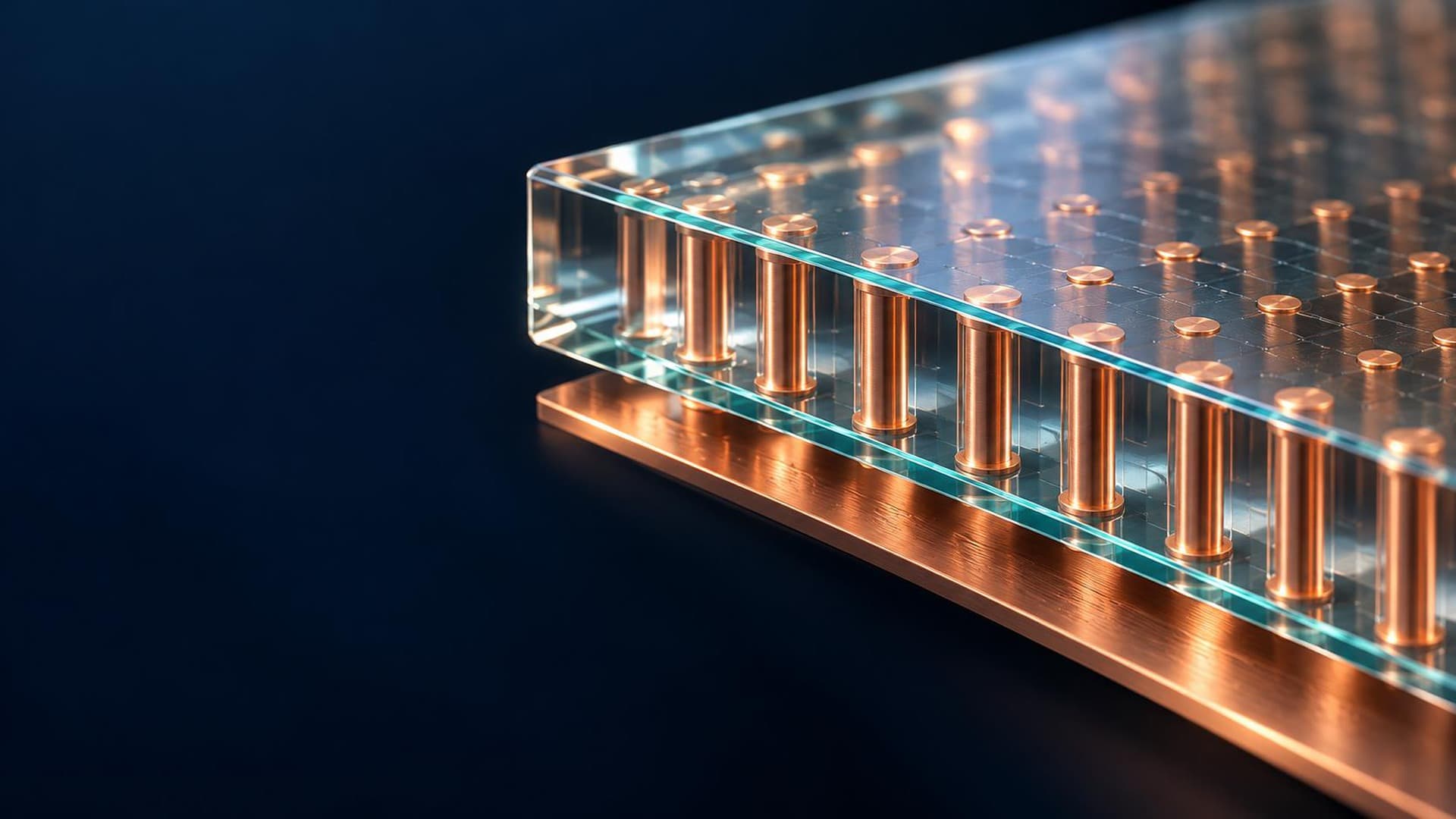
PTFE is a low-loss substrate, but its low surface energy makes copper hard to attach. This document explains the problem through the surface chemistry of dopamine, a small molecule carrying the key functional groups of mussel adhesive proteins. Its catechol, two adjacent OH groups, takes part in metal binding and redox reactions, while its primary amine takes part in acid–base behavior and cyclization. In an oxygenated solution at pH 8.5, dopamine oxidizes through a quinone and cyclizes into indole-type structures; covalent bond formation and non-covalent self-assembly act together to produce a heterogeneous functional layer in which several oxidation states and structures coexist (Lee et al. 2007, Hong et al. 2012). The remaining functional groups in this layer are where follow-on reactions happen. Catechol oxygen coordinates metal ions, quinones undergo Schiff base reactions with amines, and amines and thiols undergo Michael addition. In the patent data cited by the document, the water contact angle of PTFE was 106° untreated, 49° after PDA coating and 102° after alkanethiol post-treatment, meaning film formation can be controlled by coating time (about 50 nm in 24 hours on Si) and surface properties can be changed again with follow-on molecules. Copper metallization proceeds as Cu²⁺ adsorbs on the PDA binding sites, DMAB reduces it to form nuclei, and the nuclei grow and connect into a continuous film. The bath is CuCl₂ 50 mM, EDTA 50 mM, H₃BO₃ 0.1 M and DMAB 0.1 M at pH 7.0 and 30 °C for 2–3 hours, with DMAB added just before use. The PTFE process runs through cleaning, PDA coating (2 mg/mL, pH 8.5, 3–24 hours), rinsing, electroless copper and film build-up by electroplating. The document cites Lee et al. (2007), who demonstrated copper metallization on flexible films, three-dimensional plastics and fine patterns on glass, and presents the double-sided interface structure Cools envisions for PTFE (Cu / PDA / PTFE / PDA / Cu). PDA's value is to create metal-binding sites on the substrate surface so that a continuous electroless copper film can serve as the starting layer for wiring, and to extend to metal and organic layers by changing the surface reactions.
References
- 1. Lee, H., Dellatore, S. M., Miller, W. M., & Messersmith, P. B. (2007). Mussel-Inspired Surface Chemistry for Multifunctional Coatings. Science, 318(5849), 426–430. https://doi.org/10.1126/science.1147241
- 2. Hong, S., Na, Y. S., Choi, S., Song, I. T., Kim, W. Y., & Lee, H. (2012). Non-Covalent Self-Assembly and Covalent Polymerization Co-Contribute to Polydopamine Formation. Advanced Functional Materials, 22(22), 4711–4717. https://doi.org/10.1002/adfm.201201156
- 3. WO2008049108A1 (Messersmith·Lee).
Topics
- Plating
- Printed electronics