About this document
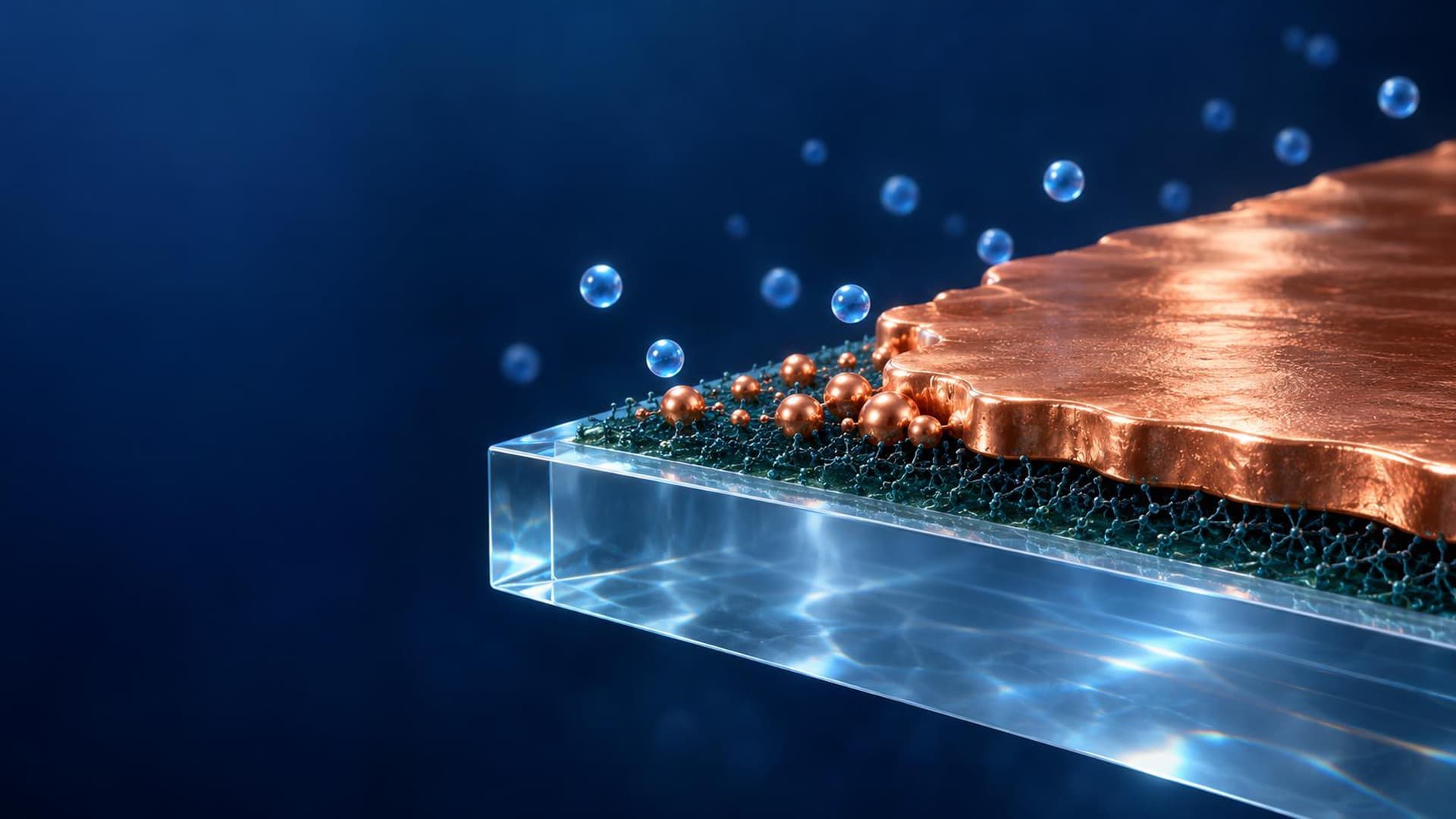
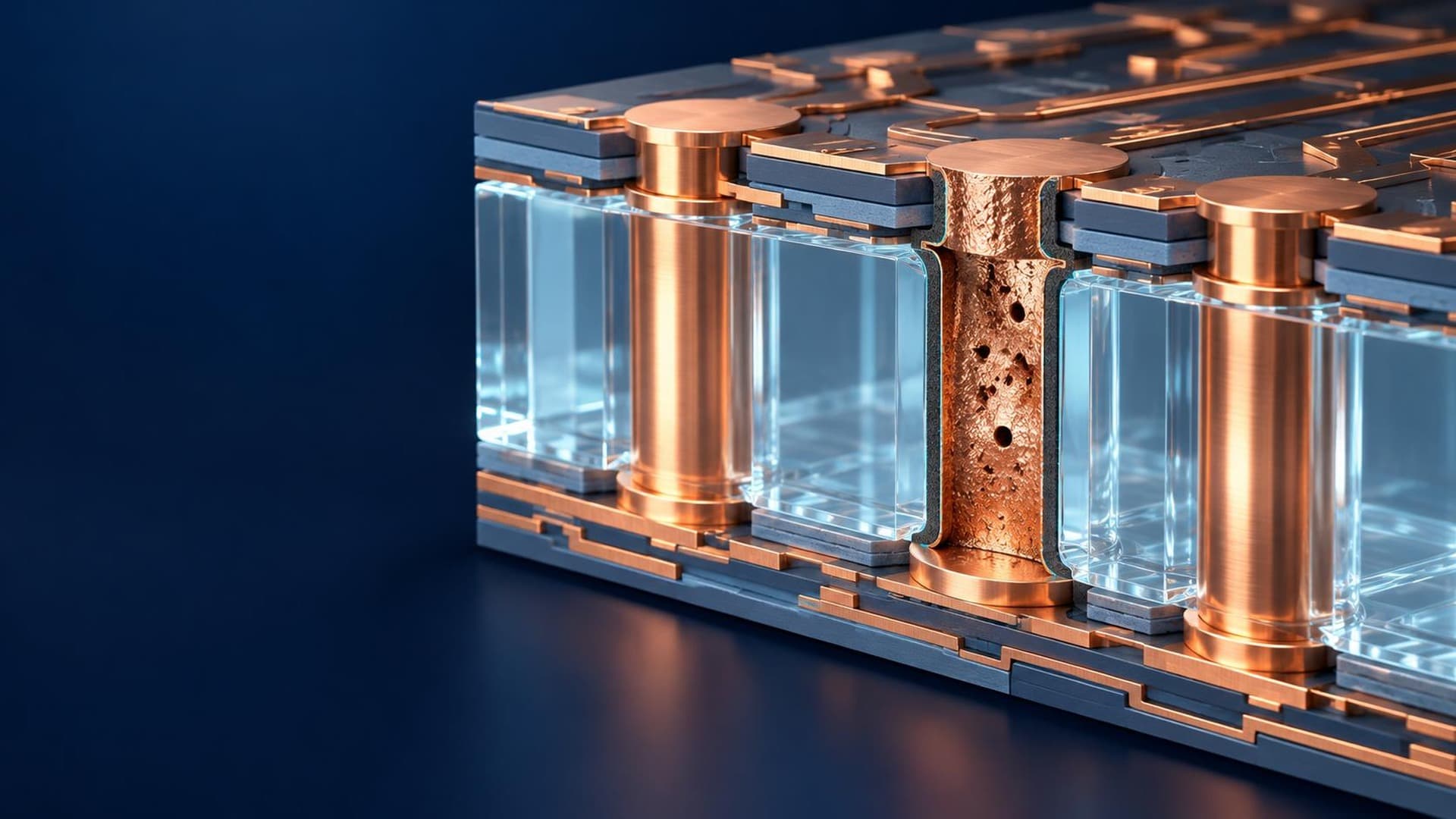
For glass vias sealed at the bottom with copper foil, this Technical Note describes a process design that makes the sidewalls hydrophilic with PDA to help the plating solution penetrate, raising the allowable current density for bottom-up filling and shortening plating time.
Download
An English edition is not available yet. The Korean document is below.
Summary
In blind vias the plating solution penetrates poorly and bubbles remain, making high-current operation difficult. Lowering the sidewall contact angle with PDA raises capillary pressure and eases solution penetration; if the allowable current density doubles, copper deposition time is halved by calculation.
Conclusion
Filling glass vias quickly means raising the current density, but in vias sealed at the bottom the inside must first be wetted evenly. Where the solution does not penetrate fully or bubbles remain, copper growth stops at that spot, and non-uniform filling worsens as current rises. An et al. (2026), cited in the document, report that on flat specimens the water contact angle rose after metallization, to 35.27° for glass, 75.43° for copper and 70.65° for nickel, and that vias that still held voids despite a metal film filled void-free at 0.3–0.7 A/dm² and aspect ratios of 6–10 once plated wet after vacuum impregnation. Cools treats sidewall wettability itself as a process variable. In Cho et al. (2016), PDA treatment lowered the water contact angle of copper foil from 93° to 46°. Using the Young–Laplace equation (ΔP = 2γ cosθ / r) at equal surface tension and via radius, the document shows a design calculation in which capillary pressure, set to 1 at a 75° contact angle, becomes 2.73 at 45° and 3.73 at 15°. In the structure, copper foil at the bottom serves as cathode and starting point for plating, while PDA coats only the sidewalls to drive solution penetration and bond copper to glass. The result is self-propagating electrodeposition (SPEA) bottom-up filling, in which the copper front rises from the bottom without sidewall sputtering. PDA coating concentration, pH and reaction time are tuned for the best wetting in the actual plating solution, and the maximum current density that still gives void-free filling is the optimization metric. The productivity effect is given by Faraday's law calculation. At the same fill depth and current efficiency, with bottom-up growth of 13.2 µm/h per A/dm², deposition time falls to 66.7% when the allowable current density rises 1.5 times, to 50% at 2 times and to 33.3% at 3 times. Three times the 0.7 A/dm² baseline, 2.1 A/dm², lies within a diffusion-limited current of 2.6 A/dm² calculated for conditions including a 300 µm depth. The document identifies these as calculated values and ties the effect to higher throughput on the same equipment and lower plating cost per panel.
References
- 1. An, H., Park, S., Kim, Y., Lee, H., Kim, G., Lee, K., Lee, S., & So, H. (2026). Vacuum-assisted void-free copper filling of high-aspect-ratio through-glass vias for advanced interposers. Journal of Materials Research and Technology, 44, 1617–1626. https://doi.org/10.1016/j.jmrt.2026.08.005
- 2. Cho, I., Gong, S., Song, D., Lee, Y.-G., Ryou, M.-H., & Lee, Y. M. (2016). Mussel-inspired Polydopamine-treated Copper Foil as a Current Collector for High-performance Silicon Anodes. Scientific Reports, 6, 30945. https://doi.org/10.1038/srep30945
Topics
- Plating
- Glass substrates