About this document
Placing several GPU dies and multiple HBM stacks on a single interposer is driving package area up sharply. The moment the area grows, warpage moves to the front of the bonding process. This brief sets out how constraining the package shape and cutting heating and cooling time fit together.
Download
An English edition is not available yet. The Korean document is below.
Summary
As interposer area increases, mismatches in the coefficient of thermal expansion accumulate and the package bows. That bow makes stand-off height and applied pressure differ from point to point across tens of thousands of joints, leading to non-wets, cold joints and bridges. Oven reflow, which heats and cools the entire assembly, struggles to hold a flat bonding plane. Two approaches are treated together: constraining the shape with a high-stiffness lid before bonding is complete, and switching the path heat travels along to shorten heating and cooling. Shape and time are separate problems, and solving one tends to worsen the other.
Conclusion
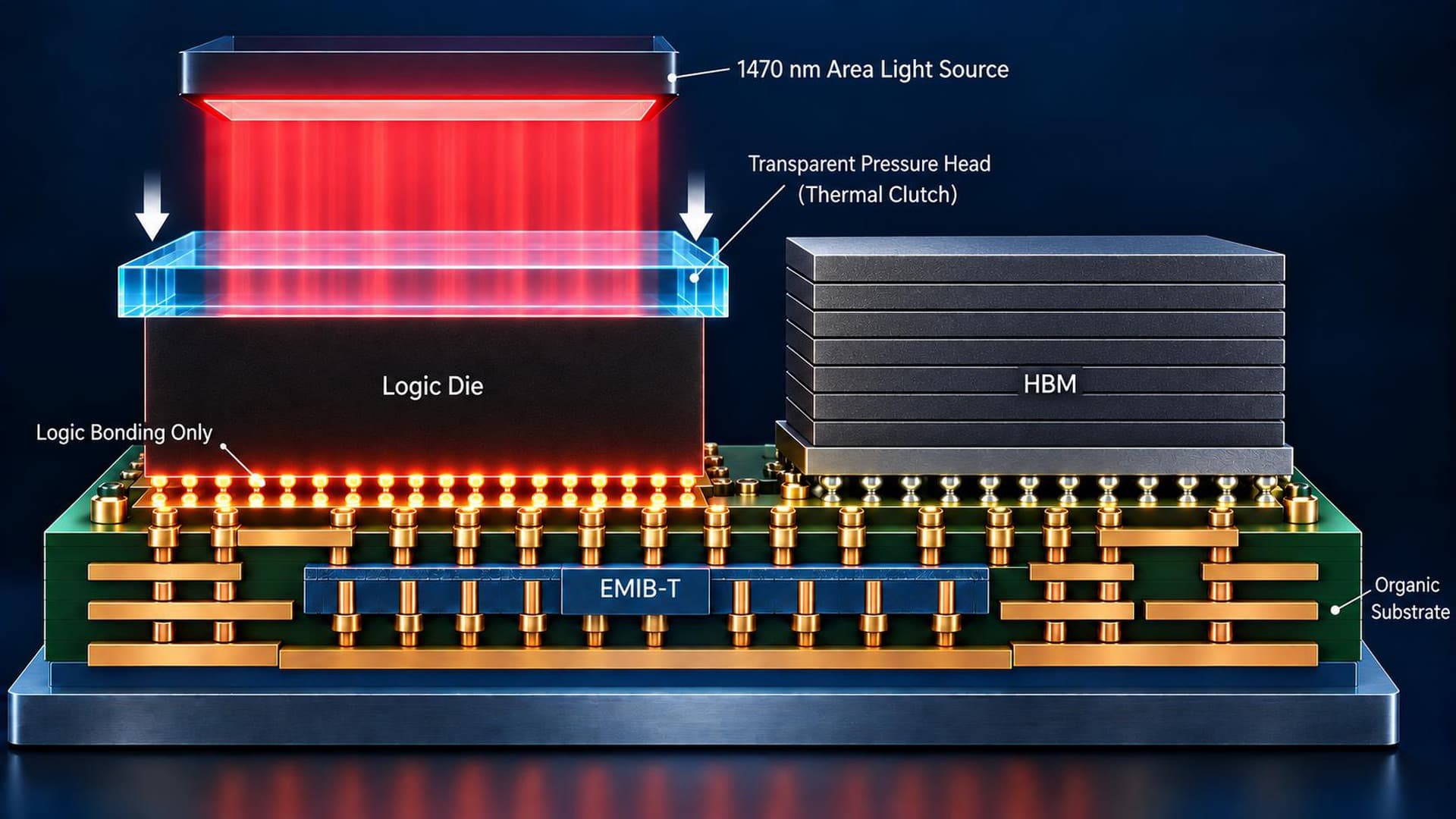
A high-stiffness lid controls the shape of the package; the Thermal Clutch controls heating and cooling time. The two are complementary, not alternatives. The lid is not a new component. What changes is the order. It is attached before bonding is complete, so its bending stiffness holds the package flat while thermocompression bonding is performed, and pressure is maintained until the solder solidifies. Instead of correcting warpage after the fact, the package is kept from bowing in the first place, so a flat bonding plane is obtained even when the coefficients of thermal expansion of the interposer and the substrate do not match exactly. The cost is time. The lid is thick and has a large heat capacity: bonding a 180 x 70 mm class package with conventional TCB takes more than a minute to heat and cool. The Thermal Clutch changes the path heat travels rather than what is heated. During heating it blocks the path from the bond head to the cooling stage so that heat concentrates at the bonding interface, and the moment bonding ends it connects the path to the cooling side. Pressure is maintained through cooling as well. Combined, the two allow a process that relied on oven reflow to move to large-area, interface-selective-heating TCB. The performance Cools states, for a 180 x 70 mm class package, is heating and cooling within 10 seconds and post-bond warpage of 0.1 mm or less.
Topics
- Packaging
- Cycle time